Web Development
WEBSITE MIGRATION
SERVICE
If your website runs on WordPress, Umbraco or a legacy CMS, you are running on infrastructure that has been fighting your team for years. We migrate businesses to Next.js: a custom-built platform that loads under a second, deploys through Git and never needs a plugin update.
START A PROJECT →THE LEGACY
CMS PROBLEM
WordPress queries a database on every page load. Umbraco requires .NET infrastructure and specialist developers who charge enterprise rates. Both need constant patching, licensed plugins and agencies whose retainers grow with every complication the platform creates.
The result is a website that moves at the pace of your most expensive vendor. New pages need a developer ticket, and plugin updates routinely break something else. Meanwhile, your team needs the site to move as fast as the business does.
We build on Next.js, where pages generate statically and load in under a second. Your team deploys changes through Git, with no plugin queue, no server management and no agency needed for content updates.

PLATFORMS WE
MIGRATE FROM
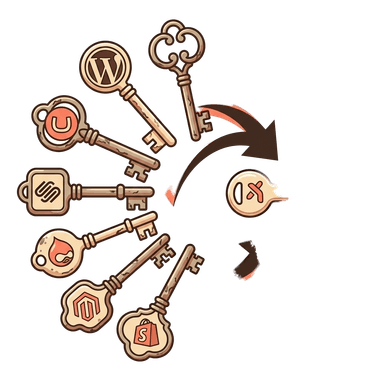
Every migration starts with a full audit of your existing site: URL structure, content types, forms, media assets and any custom functionality. Nothing is rebuilt until we know what needs to carry over and what can be improved in the process.
- WordPress
- Umbraco
- Squarespace
- Wix
- Drupal
- HubSpot CMS
Included in every migration
- Full URL audit and 301 redirect map: no ranking signals lost
- Content migration into Next.js components
- SEO signal preservation: titles, meta descriptions, schema
- Core Web Vitals compliance from launch day
- Zero-downtime deployment: old site stays live until the new one is tested
HOW THE
MIGRATION WORKS

Audit
We map your existing URL structure, content types, forms and integrations. Nothing moves until we know exactly what is there.
Architecture
We design the Next.js component structure, URL mapping and redirect rules. The new architecture is cleaner than the original.
Rebuild
Your content is rebuilt in Next.js. We do not copy-paste into templates. Each component is written for your content model.
QA
Every redirect is tested. Every page loads in under a second. Every form submits. We check Core Web Vitals before go-live.
Launch
The new site goes live. The old one is retired. Redirects propagate. We monitor rankings for 30 days post-launch.
HOW LONG
IT TAKES
Most migrations take three to five weeks from audit to launch. The timeline depends on site size and whether custom integrations, such as booking systems, member portals or API connections, need to be rebuilt.
Hostinger can move a WordPress site to a new server in a day, but that is a hosting transfer. The files land somewhere new; the platform problems come with them. If you want to get off the platform entirely, three to five weeks is what it takes to do it properly.

WHAT IT
COSTS
Migrations start at $7,500. Most corporate and institutional projects run $12,000–$25,000 depending on the volume of pages, content types and custom functionality that needs to be rebuilt.
SEO preservation is included in every engagement: redirect mapping, signal validation and 30 days of post-launch ranking monitoring at no additional cost.

COMMON
QUESTIONS
- How much does it cost to migrate a website?
- A hosting-level migration (moving files to a new server) is often free with any hosting plan. A CMS migration, rebuilding a site from WordPress or Umbraco onto a modern framework like Next.js, is a development project. Our migrations start at $7,500 and run $12,000–$25,000 for larger sites with complex content models or custom integrations.
- What is a website migration service?
- A migration means different things depending on who you ask. A hosting provider means moving your files to their servers. We mean rebuilding your site on a modern platform while preserving your URL structure, rankings and content. The difference matters: one takes a day, the other takes three to five weeks and requires a developer who understands redirect mapping and structured data.
- How do I migrate a website from WordPress to Next.js?
- You audit the existing site first: every URL, content type, media asset and form. Then you design the component architecture for the new platform, rebuild the content, map 301 redirects for every URL that is changing, and QA before you cut over. If rankings matter, you also validate structured data, meta tags and crawlability before launch day.
- Does migrating a website affect SEO?
- Yes, done poorly, a migration can hurt SEO. Missed redirects, changed URL structures and missing meta tags can drop rankings significantly. Done correctly, migrations improve SEO: the new site passes Core Web Vitals from day one, the URL structure is cleaner, and schema markup is built in from the start rather than retrofitted later.
WHAT USUALLY
COMES WITH IT
Migrations rarely arrive on their own. Most start as a website redesign where the client works out halfway through that the CMS is the real constraint, and a fair number end up needing UX and UI design for the application layer once the marketing pages are settled. You can see how the pieces fit together on the services overview.
LET'S PLAN
YOUR MIGRATION
Tell us what platform you're on and what's not working. We'll let you know how long it takes and what it costs.
START A PROJECT →